Mostrando entradas con la etiqueta charter. Mostrar todas las entradas

sábado, 25 de febrero de 2023

Hispania

Otra aerolínea charter española de la década de 1980, que durante su corta existencia (entre 1982 y 1988) fue bastante exitosa y tuvo un rápido crecimiento... que fue en cierta medida la causa de su final, ya que no fue capaz de asumir los costes de operar con una flota que había aumentado con los años. 

Inicialmente operó con dos Caravelle pero más tarde lo hizo con Boeing 737 y también con el 757, del que fue la primera operadora en España aunque LTE insistiera en su publicidad en lo contrario. 

Air Europa estuvo a punto de hacerse con el control de esta compañía, pero finalmente no llegó a ocurrir. 

Este es un folleto de presentación de la empresa en el que nuevamente podemos ver cómo las charter de la época hacían grandes esfuerzos por dar una imagen de "seriedad" y parecerse lo más posible al prestigio que se asociaba entonces a las compañías de bandera, queriendo imitarlas en casi todo lo que ofrecían, tanto en tierra como  a bordo, al menos en clase turista. 

✈✈✈ ✈✈✈ ✈✈✈ ✈✈✈ ✈✈✈ ✈✈✈ ✈✈✈ ✈✈✈ ✈✈✈

Another Spanish charter airline from the 1980s, which during its short existence (between 1982 and 1988) was quite successful and had a rapid growth... this was to some extent the cause of its demise, as it was not able to assume the costs of operating with a fleet that had increased over the years. 

Initially it operated with two Caravelle but later it flew Boeing 737s and also the 757, being the first operator in Spain although LTE insisted in its advertising otherwise. 

Air Europa was on close to taking control of this company, but eventually this did not happen. 

Here is a presentation brochure of the airline in which we can once again see how charter airlines of the time were making great efforts to give an image of " reliability" and to be as close as possible to the reputation associated at the time with the flag carriers, trying to mimic them in almost everything they offered, both on the ground and on board, at least in economy class. 


(Gracias a Alexander Scholer / del grupo Spain's charter airlines  por algunas de las imágenes de este post) 

lunes, 20 de febrero de 2023

Volar con Futura (2003)

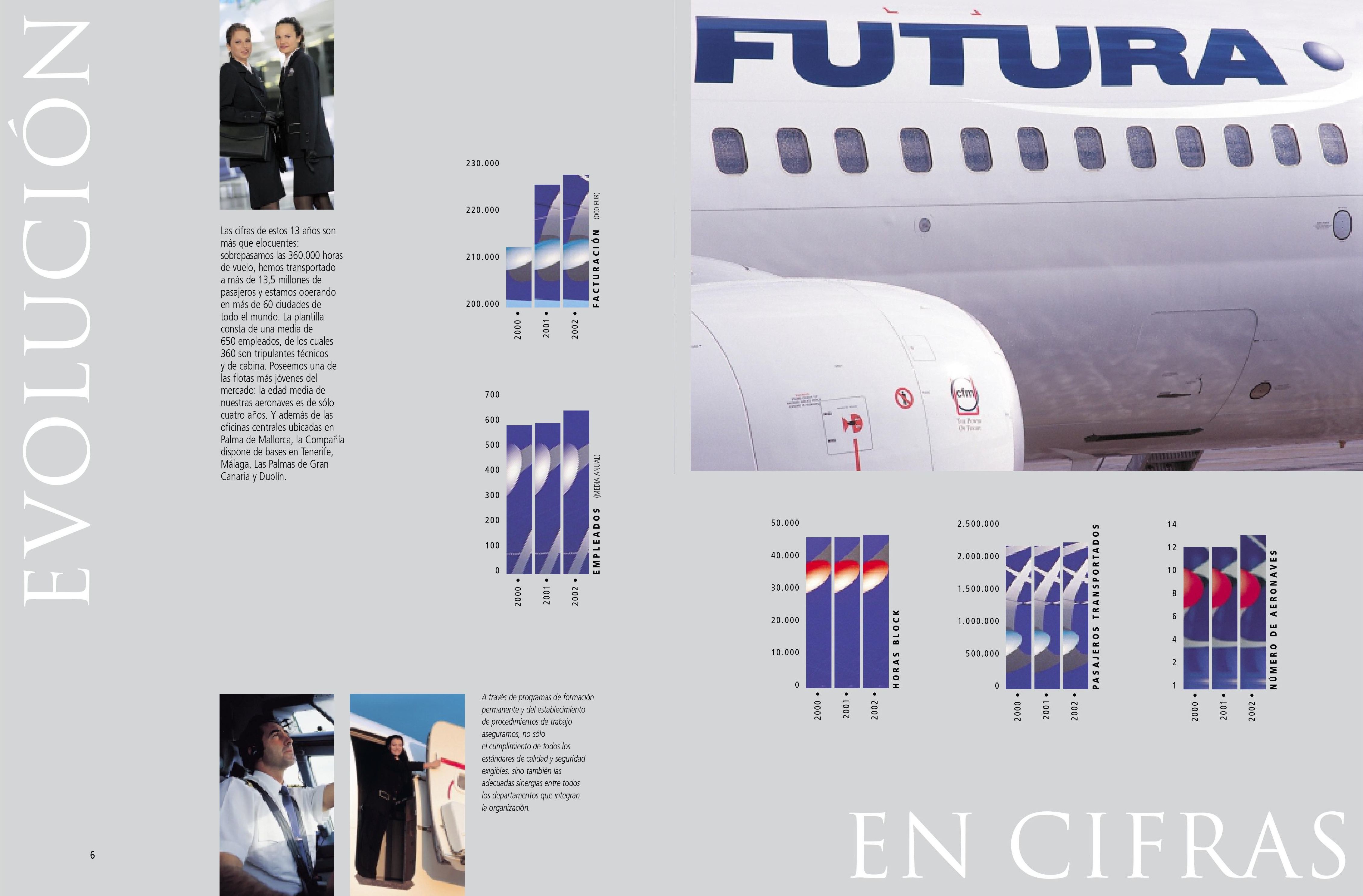
Futura, nacida en 1990 dela mano de Aer Lingus, fue una de las grandes  aerolíneas charter españolas (y tambíén de las últimas), operando de una forma muy clásica en colaboración con tour operadores y enfocada casi al 100% en el mercado turístico y vacacional.  Este es un folleto que da una presentación de la compañía, sus resultados económicos, sus servicios y sus planes de renovación de flota. 

Esta era una época en la que los vuelos charter eran la mejor opción para viajar de forma mucho más asequible y al mismo timepo las compañías hacían un gran esfuerzo por proporcionar un servicio que se pareciera lo más posible al de las grandes compañías regulares. Esto se puede ver en muchos detalles, incluyendo el uniforme de las TCP que pretendía alejarse del modelo vacacional y dar una imagen de seriedad y profesionalidad. 

En cualquier caso, es triste ver como la empresa, que  incluso se aventuró en el mercado regular, terminó cerrando de forma abrupta en medio de una gestión bastante discutible unos pocos años después de que se publicara esta revista. 

✈✈✈ ✈✈✈ ✈✈✈ ✈✈✈ ✈✈✈ ✈✈✈ ✈✈✈ ✈✈✈ ✈✈✈

Futura, born in 1990 as part of the Aer Lingus, was one of the great Spanish charter airlines (and also one of the last), operating in a very classic way in collaboration with tour operators and focused almost 100% on the tourist and holiday market.  This is a brochure that gives a presentation of the company, its financial results, its services and its fleet renewal plans. 

This was a time when charter flights were the best option to travel in a much more affordable way and at the same time the companies made a great effort to provide a service that was as close as possible to that of the big scheduled airlines. This can be seen in many details, including the uniform of the flight attendants, which was designed to give an image of seriousness and professionalism. 

In any case, it is sad to see how the company, which even operated some scheduled flights, ended up closing abruptly in the midst of a rather questionable management a few years after this magazine was published.


lunes, 3 de septiembre de 2018

Aviaco (1983) " Behind this sign there is a whole new world to discover"

Un folleto de presentación de Aviaco y su actividad dual como operadora doméstica (nótese el mapa de rutas con aeropuertos que hoy apenas cuentan con un servicio muy ocasional, como Badajoz, o que directamente no tienen, como Córdoba o La Seu d'Urgell) que incluye también alguna foto de su flota de reactores compuesta por DC-9 y DC-8 en aquel momento.

✈✈✈ ✈✈✈ ✈✈✈ ✈✈✈ ✈✈✈ ✈✈✈ ✈✈✈ ✈✈✈ ✈✈✈

A simple brochure introducing Aviaco and its "jet fleet" of DC-9 and DC-8 aircraft at the time as both a charter carrier and the Spanish domestic airline. The routemap shows some airports with currently receive very little scheduled traffic, such as Badajoz or which do not receive any at all, like Córdoba or La Seu d'Urgell. 


martes, 28 de febrero de 2017

ACE (Aerolíneas CEMESA) (1980)

Puesto que hoy, 28 de Febrero, es el día de Andalucía, vamos a recordar en este post uno de esos extraños intentos que hubo a principios de los 80 de introducir la aviación regional en España, en una época en la que había que sortear el monopolio absoluto que tenía en el tráfico doméstico Iberia y sus filiales.

Aerolíneas Cemesa era una empresa relacionada con inversiones hoteleras en Andalucía y con el servicio de grúa municipal de Madrid que intentó crear unas "primeras líneas andaluzas" en 1980 y 1981, volando con el Aviocar de Construcciones Aeronáuticas, fabricado en Sevilla, con lo cual se anunciaba también como "la aerolínea con una flota integramente andaluza".

Como seguramente sabréis, la única forma de burlar la legislación de la época era publicitando los servicios como vuelos chárter, aunque en la práctica la intención era ofrecer una operación regular.

✈✈✈ ✈✈✈ ✈✈✈ ✈✈✈ ✈✈✈ ✈✈✈ ✈✈✈ ✈✈✈ ✈✈✈

This was a short-lived attempt at having an Andalusian-owned airline flying regional flights within the Andalusia region, using a "100% Andalusian fleet" of Aviocar planes, which were built by CASA in Seville.

Since only Iberia and its subsidiaries were allowed to fly domestic sheduled flights at the time, the airline had to operate under as a charter carrier, even if it was a somewhat undercover sheduled scheme. 


Enlaces (links)