Mostrando entradas con la etiqueta folletos (brochures). Mostrar todas las entradas

martes, 16 de enero de 2024

Iberia (1969)

En realidad, este es un bonus track del anterior post de Iberia del año 1969, con los contenidos de una carpeta que daba la bienvenida a bordo y algunos materiales promocionales: postales, una carta al director con un mapa de rutas, etc

✈✈✈ ✈✈✈ ✈✈✈ ✈✈✈ ✈✈✈ ✈✈✈ ✈✈✈ ✈✈✈ ✈✈✈

Actually, this is a bonus track from the previous post about Iberia in 1969, with the contents of a folder welcoming you on board and some promotional materials: postcards, a letter to the editor with a route map, etc.


lunes, 30 de octubre de 2023

Southern Winds "Lo llevamos a disfrutar lo mejor de la Argentina"

Este folleto está sin fechar, pero sin duda corresponde al breve periodo, alrededor de 2004, en el que la empresa argentina voló a Madrid con sus 767 y está editado por su GSA en España. 

Southern Winds, con sede en Córdoba,  fue una aerolínea muy exitosa en un principio, y llegó a un acuerdo con el Estado Argentino para hacerse cargo de dos empresas privadas que habían quebrado, Dinar LAPA. Estas dos empresas privadas se habían fusionado, al menos de forma teórica, en una empresa estatal llamada LAFSA (Lineas Aéreas Federales) que no tenía aviones y no realizaba ningún vuelo. En virtud de este acuerdo, el Estado financiaba el combustible de SW. Por eso aparece el logotipo de Federales en la portada al lado del de Southern Winds. 

Todo iba bien hasta que este acuerdo quedó sin efecto después de que aparecieran maletas con droga en un avión de SW en Barajas, lo cual significó, de hecho, el fin de la empresa.  

✈✈✈ ✈✈✈ ✈✈✈ ✈✈✈ ✈✈✈ ✈✈✈ ✈✈✈ ✈✈✈ ✈✈✈

This brochure is undated, but certainly dates from the brief period, around 2004,  when the Argentinian company flew its 767s to Madrid, and is published by its GSA in Spain. 

Southern Winds, based in Cordoba, was a very successful airline in the beginning, and reached an agreement with the Argentine state to take over two private companies that had gone bankrupt, Dinar and LAPA. These two private companies had merged, at least theoretically, into a state-owned company called LAFSA (Lineas Aéreas Federales) which had no aircraft and did not operate any flights. Under this arrangement, the State funded SW's fuel. That is why the Federales logo appears on the front cover next to the Southern Winds logo. 

Everything was going well until this arrangement was rendered ineffective after suitcases containing drugs were found on a SW plane in Madrid airport, which meant, in effect, the end of the company.


jueves, 19 de octubre de 2023

Rif Airways (2009)

Como ya he dicho muchas veces, la aviación regional en España es un sector que, exceptuando los casos de Binter y Air Nostrum, que son bastante particulares, nunca han tenido especial éxito. 

Reconozco que nunca había oído hablar de Rif Airways hasta que me llegó este folleto. Se trataba de una aerolínea con base en Nador y que pretendía cubrir una necesidad de conectividad aérea entre el norte de Marruecos y la Península. Era una filial conjunta de otra aerolínea de la que nunca había oído hablar, Mexwings (que aunque parece lo contrario no tiene nada que ver con México y era un operador privado marroquí) y Andalus Líneas Aereas, una aerolínea regional española con base en Málaga que operaba con Embraer 145. 

Aparentemente estos vuelos, o algunos de ellos, ya los operaba Mexwings como operaciones charter y la alianza con Andalus tenía como objetivo establecer una aerolínea regular entre ambos países. 

Aunque el folleto está sin fechar, esta aventura tuvo lugar en 2009. 

✈✈✈ ✈✈✈ ✈✈✈ ✈✈✈ ✈✈✈ ✈✈✈ ✈✈✈ ✈✈✈ ✈✈✈

As I have said many times before, in Spain regional aviation is a sector that, with the exception of Binter and Air Nostrum, which are quite particular, has never been particularly successful. 

I must admit that I had never heard of it until I received this brochure from Rif Airways, an airline based in Nador that sought to fill a need for air connectivity between the north of Morocco and the Iberian Peninsula. It was a joint subsidiary of another airline I had never heard of, Mexwings (which, although it seems otherwise, has nothing to do with Mexico and was a private Moroccan operator) and Andalus Líneas Aereas, a Spanish regional airline based in Malaga that operated Embraer 145s. 

Apparently these flights, or some of them, were already operated by Mexwings as charter operations and the alliance with Andalus was intended to establish a scheduled airline between the two countries. 

Although the brochure is undated, this venture took place in 2009. 


viernes, 25 de agosto de 2023

Iberia (1979/1980), Reino Unido "Winter fare deals"

Un folleto con horarios provisionales y tarifas para el invierno de 1979/1980 con la oferta de Iberia saliendo del aeropuerto de Londres Heathrow. Casi todos los servicios con 727 y DC-9, que fueron durante muchísimo tiempo la base de su flota en el corto radio, aunque también operaban algún vuelo con DC-10. 

Lógicamente, con un mercado hiper regulado como estaba entonces, Iberia era la "número 1" entre España y el Reino Unido, ya que ninguna otra podía ofrecer una cobertura tan extensa de destinos domésticos. Literalmente no había otras opciones. 

✈✈✈ ✈✈✈ ✈✈✈ ✈✈✈ ✈✈✈ ✈✈✈ ✈✈✈ ✈✈✈ ✈✈✈

A brochure with provisional timetables and fares for the winter of 1979/1980 with the Iberia offer departing from London Heathrow airport. Almost all services with 727 and DC-9, which were for a very long time the basis of their short haul fleet, although they also operated some flights with DC-10. 

Logically, with a hyper-regulated market as it was then, Iberia was the "number 1" between Spain and the UK, as no other airline could offer such extensive coverage of domestic destinations. There were literally no other options. 


jueves, 13 de abril de 2023

Los DC-2 de LAPE (Líneas Aéreas Postales Españolas)

La compañía estatal  Líneas Aéreas Postales Españolas fue creada en 1932 como sucesora y heredera de ✈CLASSA y supuso el despegue definitivo de la aviación comercial en España. 

Su flota en aquellos inicios era bastante heterogénea (algo lógico, siendo como era el resultado de la concentración de varias empresas anteriores). Sin embargo, de cara a un previsible crecimiento de la red (más allá de la red doméstica que unía Madrid, Sevilla y Barcelona con las islas) y homogenizar la flota en términos de confort y calidad, la introducción del DC-2 en 1935 supuso un importantisimo punto de inflexión. 

Desgraciadamente, el golpe militar de 1936 y la guerra entre el gobierno republicano y los sublevados fascistas hizo que las operaciones de LAPE se vieran muy reducidas y su material fuera utilizado principalmente para transporte militar. 

✈✈✈ ✈✈✈ ✈✈✈ ✈✈✈ ✈✈✈ ✈✈✈ ✈✈✈ ✈✈✈ ✈✈✈

The state-owned company Líneas Aéreas Postales Españolas was created in 1932 as the successor and heir of ✈CLASSA and represented the definitive take-off of commercial aviation in Spain. 

Its fleet in those early days was quite heterogeneous ( unsurprisngly, since it was the result of the concentration of several previous companies) The entry into service of the Douglas DC-2, a very modern aircraft at that time, was a very important turning point aiming at the future growth of the airline. 

Unfortunately, the military coup of 1936 and the war between the Republican government and the fascist rebels meant that LAPE's operations were greatly reduced and its material was mainly used for military transport.


El DC-2 era el avión comercial más rápido y moderno de su momento, y no es de extrañar que la compañía hiciera toda una campaña de promoción de este modelo en su material promocional. Como por ejemplo en este folleto, en el que se representaba el interior y el exterior de un DC-2 en vuelo, además de los destinos de la compañía y fotos de los mismos: 

The DC-2 was the fastest and most modern commercial airplane of its time, and it is not surprising that the company made a whole campaign to promote this model in its promotional material. As for example in this brochure, which depicted the interior and exterior of a DC-2 in flight, in addition to the airline's destinations and photos of them:


En una serie de pegatinas dedicadas a su flota histórica Iberia dedicó una de ellas al DC-2 de LAPE. De hecho, Iberia, como sucesora de la aerolínea republicana, continuó volando con algunos de estos aviones al final de la guerra. Lo que es francamente criticable es que hayan editado esta pegatina sin usar los colores de la bandera republicana. 

Iberia dedicated one sticker to the LAPE DC-2 as part of a series of stickers commemorating its historic fleet. As a matter of fact, Iberia, as the successor of the former Spanish Republic airline, continued flying some of these aircraft at the end of the war. However, the fact that they have edited this sticker without using the colors of the Spanish Republic flag is something to be rejected.


En estos carteles publicitarios de LAPE el DC-2, auténtico orgullo y alegría de la flota en aquel momento, tienen también un destacado papel protagonista: 

Aunque esta era una época en la que la identidad corporativa no tenía ni de lejos, ni por asomo, la importancia de hoy en día, se aprecia también un cierto intento de empezar a usar un logotipo que representase a LAPE junto con la grulla, que ya había sido utilizada anteriormente por CLASSA.

El segundo poster, de 1935, muestra un mapa de rutas en el momento de mayor expansión de la compañía, que operaba vuelos a Francia y Alemania en cooperación con otras grandes aerolíneas del momento, Air France y Lufthansa. España se empezaba a conectar por via aérea con el resto del continente con una línea aérea que se empezaba a parecer a las que conocemos hoy en día, y que estaba a la misma altura que las de las principales potencias europeas. 

In these LAPE advertising posters the DC-2, the great pride and joy of the fleet at the time, also plays a prominent role: 

Although this was a time when corporate identity was nowhere near as important as it is today, there is also a discernible attempt to start using a logo to represent LAPE along with the crane, which had been used previously by CLASSA.

The second poster, from 1935, shows a route map at the time of the company's greatest expansion, operating flights to France and Germany in cooperation with other major airlines of the time, Air France and Lufthansa. Spain was beginning to be connected by air with the rest of the continent with an airline that was beginning to resemble modern airlines, and that was at the same level as those of the leading European countries.


También era una constante, en esta época, hacer alusión a la seguridad que suponía viajar con LAPE. La empresa presumía, triunfante, de no haber sufrido ningún accidente y del número de km recorridos. Este tipo de comparaciones con el número de vueltas al mundo que se podrían hacer es un tópico de la publicidad de empresas de aviación que se ha seguido usando hasta hace muy poco (¿o quizás todavía se use?) y que sólo es comparable al de intentar explicarnos el tamaño de algo en campos de fútbol. 

It was also a constant, at this time, to refer to the safety of travelling with LAPE. The company triumphantly boasted of having had no accidents and of the number of kilometres travelled. This kind of comparison with the number of round-the-world trips that could be made is a cliché in aviation advertising that has continued to be used until very recently (or perhaps it is still used?) and is only comparable to trying to explain the size of something in football pitches.


En el primer poster podemos ver, como antes, un primer intento de introducir una imagen de marca que identifique a la empresa, además de que aparecen la multitud de aparatos que componían su flota; en el segundo el DC-2 vuelve a ser el protagonista absoluto del cartel. 

In the first image we can see, as before, a first attempt to introduce a brand image that identifies the company, as well as the multitude of aircraft that made up its fleet; in the second, the DC-2 is once again the absolute protagonist of the poster.


sábado, 25 de febrero de 2023

Hispania

Otra aerolínea charter española de la década de 1980, que durante su corta existencia (entre 1982 y 1988) fue bastante exitosa y tuvo un rápido crecimiento... que fue en cierta medida la causa de su final, ya que no fue capaz de asumir los costes de operar con una flota que había aumentado con los años. 

Inicialmente operó con dos Caravelle pero más tarde lo hizo con Boeing 737 y también con el 757, del que fue la primera operadora en España aunque LTE insistiera en su publicidad en lo contrario. 

Air Europa estuvo a punto de hacerse con el control de esta compañía, pero finalmente no llegó a ocurrir. 

Este es un folleto de presentación de la empresa en el que nuevamente podemos ver cómo las charter de la época hacían grandes esfuerzos por dar una imagen de "seriedad" y parecerse lo más posible al prestigio que se asociaba entonces a las compañías de bandera, queriendo imitarlas en casi todo lo que ofrecían, tanto en tierra como  a bordo, al menos en clase turista. 

✈✈✈ ✈✈✈ ✈✈✈ ✈✈✈ ✈✈✈ ✈✈✈ ✈✈✈ ✈✈✈ ✈✈✈

Another Spanish charter airline from the 1980s, which during its short existence (between 1982 and 1988) was quite successful and had a rapid growth... this was to some extent the cause of its demise, as it was not able to assume the costs of operating with a fleet that had increased over the years. 

Initially it operated with two Caravelle but later it flew Boeing 737s and also the 757, being the first operator in Spain although LTE insisted in its advertising otherwise. 

Air Europa was on close to taking control of this company, but eventually this did not happen. 

Here is a presentation brochure of the airline in which we can once again see how charter airlines of the time were making great efforts to give an image of " reliability" and to be as close as possible to the reputation associated at the time with the flag carriers, trying to mimic them in almost everything they offered, both on the ground and on board, at least in economy class. 


(Gracias a Alexander Scholer / del grupo Spain's charter airlines  por algunas de las imágenes de este post) 

lunes, 20 de febrero de 2023

Volar con Futura (2003)

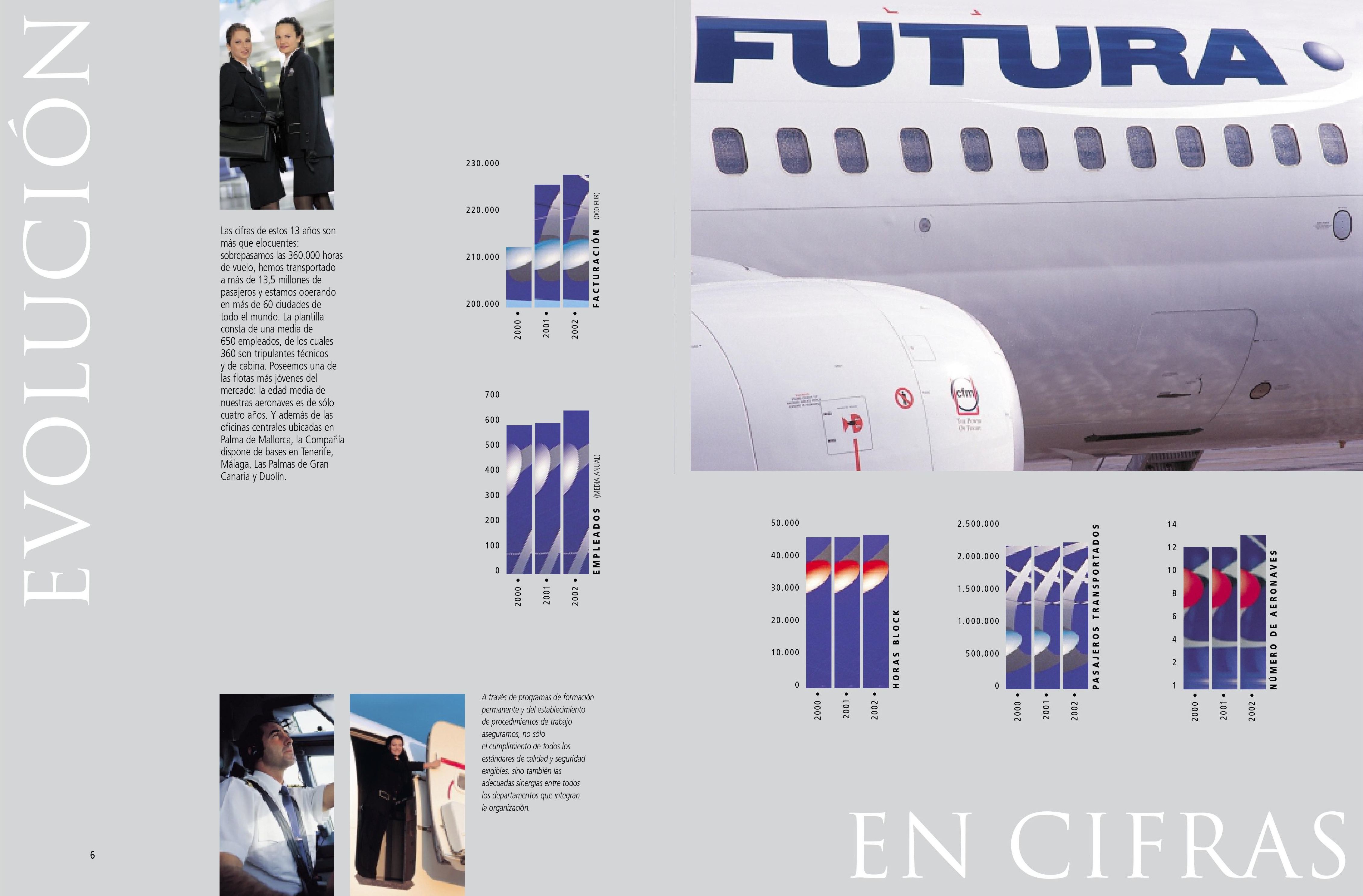
Futura, nacida en 1990 dela mano de Aer Lingus, fue una de las grandes  aerolíneas charter españolas (y tambíén de las últimas), operando de una forma muy clásica en colaboración con tour operadores y enfocada casi al 100% en el mercado turístico y vacacional.  Este es un folleto que da una presentación de la compañía, sus resultados económicos, sus servicios y sus planes de renovación de flota. 

Esta era una época en la que los vuelos charter eran la mejor opción para viajar de forma mucho más asequible y al mismo timepo las compañías hacían un gran esfuerzo por proporcionar un servicio que se pareciera lo más posible al de las grandes compañías regulares. Esto se puede ver en muchos detalles, incluyendo el uniforme de las TCP que pretendía alejarse del modelo vacacional y dar una imagen de seriedad y profesionalidad. 

En cualquier caso, es triste ver como la empresa, que  incluso se aventuró en el mercado regular, terminó cerrando de forma abrupta en medio de una gestión bastante discutible unos pocos años después de que se publicara esta revista. 

✈✈✈ ✈✈✈ ✈✈✈ ✈✈✈ ✈✈✈ ✈✈✈ ✈✈✈ ✈✈✈ ✈✈✈

Futura, born in 1990 as part of the Aer Lingus, was one of the great Spanish charter airlines (and also one of the last), operating in a very classic way in collaboration with tour operators and focused almost 100% on the tourist and holiday market.  This is a brochure that gives a presentation of the company, its financial results, its services and its fleet renewal plans. 

This was a time when charter flights were the best option to travel in a much more affordable way and at the same time the companies made a great effort to provide a service that was as close as possible to that of the big scheduled airlines. This can be seen in many details, including the uniform of the flight attendants, which was designed to give an image of seriousness and professionalism. 

In any case, it is sad to see how the company, which even operated some scheduled flights, ended up closing abruptly in the midst of a rather questionable management a few years after this magazine was published.


jueves, 16 de febrero de 2023

Quantum Air (2009)

Aebal era una operadora regional de Spanair, con sede en Palma de Mallorca, 100% propiedad de SAS y que realizaba vuelos para la compañía española con una flota de Boeing 717. 

Tras el cierre de Spanair la compañía fue vendida por SAS al grupo Proturin, adoptó el nombre Quantum Air y comenzó una breve operación en solitario con una nueva estrategia de negocio, centrada en el tráfico vacacional doméstico español y de la mano de un tour operador. 

Desgraciadamente, la compañía dejó de volar apenas un año después, entre acusaciones mutuas entre los nuevos propietarios y SAS

✈✈✈ ✈✈✈ ✈✈✈ ✈✈✈ ✈✈✈ ✈✈✈ ✈✈✈ ✈✈✈ ✈✈✈

Aebal was a regional operator of Spanair, based in Palma de Mallorca, 100% owned by SAS and operating flights for the Spanish airline with a fleet of Boeing 717s. 

After the closure of Spanair the company was sold by SAS to the Proturin group, adopted the name Quantum Air and started a brief stand-alone operation with a new business strategy, focused on Spanish domestic holiday traffic working together with a tour operator. 

Unfortunately, the company stopped operations barely a year later, amid mutual accusations between the new owners and SAS.


 Esta presentación en prensa de los primeros vuelos de la compañía, con su slogan Llegó para quedarse,  es triste y deliciosamente irónica a la vez. La compañía estuvo operando durante apenas un año, en realidad un poco menos. (fuente)

Quantum Air's slogan "Here to stay" turned out to be bitterly sad and ironic at the same time. The airline only lasted about a year in the skies before it was grounded. 


En esa época el mercado doméstico en España estaba ya dominado absolutamente por las estrategias de las low cost, y Quantum pretendía ofrecer una experiencia de vuelo como las de antes, con catering a bordo y facturación y elección de plaza gratuitas. 

Por otro lado, al ser una aerolínea centrada en el viajero que iba de vacaciones a las islas, su oferta era 100% clase turista. 

At that time the domestic market in Spain was already absolutely dominated by low-cost strategies, and Quantum aimed to offer an in-flight experience as in the past, serving light meals onboard and free check-in and seat selection. 

On the other hand, being an airline focused on the leisure traveler to the islands, the airline was offering a 100% economy class cabin. 


Además de las operaciones charter, sus vuelos regulares estaban centrados en las islas, volando a Palma de Mallorca y a Canarias desde Madrid, Barcelona y Bilbao, a la que más tarde se unió Sevilla. 

In addition to charter operations, its scheduled flights were focused on the islands, flying to Palma de Mallorca and the Canary Islands from Madrid, Barcelona and Bilbao, later joined by Seville. 


Mapa de rutas y cuadros de vuelo de la operación regular de Quantum en el verano de 2009

Route map and timetables for Quantum's scheduled flights in the summer of 2009