sábado, 25 de febrero de 2023

Hispania

Otra aerolínea charter española de la década de 1980, que durante su corta existencia (entre 1982 y 1988) fue bastante exitosa y tuvo un rápido crecimiento... que fue en cierta medida la causa de su final, ya que no fue capaz de asumir los costes de operar con una flota que había aumentado con los años. 

Inicialmente operó con dos Caravelle pero más tarde lo hizo con Boeing 737 y también con el 757, del que fue la primera operadora en España aunque LTE insistiera en su publicidad en lo contrario. 

Air Europa estuvo a punto de hacerse con el control de esta compañía, pero finalmente no llegó a ocurrir. 

Este es un folleto de presentación de la empresa en el que nuevamente podemos ver cómo las charter de la época hacían grandes esfuerzos por dar una imagen de "seriedad" y parecerse lo más posible al prestigio que se asociaba entonces a las compañías de bandera, queriendo imitarlas en casi todo lo que ofrecían, tanto en tierra como  a bordo, al menos en clase turista. 

✈✈✈ ✈✈✈ ✈✈✈ ✈✈✈ ✈✈✈ ✈✈✈ ✈✈✈ ✈✈✈ ✈✈✈

Another Spanish charter airline from the 1980s, which during its short existence (between 1982 and 1988) was quite successful and had a rapid growth... this was to some extent the cause of its demise, as it was not able to assume the costs of operating with a fleet that had increased over the years. 

Initially it operated with two Caravelle but later it flew Boeing 737s and also the 757, being the first operator in Spain although LTE insisted in its advertising otherwise. 

Air Europa was on close to taking control of this company, but eventually this did not happen. 

Here is a presentation brochure of the airline in which we can once again see how charter airlines of the time were making great efforts to give an image of " reliability" and to be as close as possible to the reputation associated at the time with the flag carriers, trying to mimic them in almost everything they offered, both on the ground and on board, at least in economy class. 


(Gracias a Alexander Scholer / del grupo Spain's charter airlines  por algunas de las imágenes de este post) 

lunes, 20 de febrero de 2023

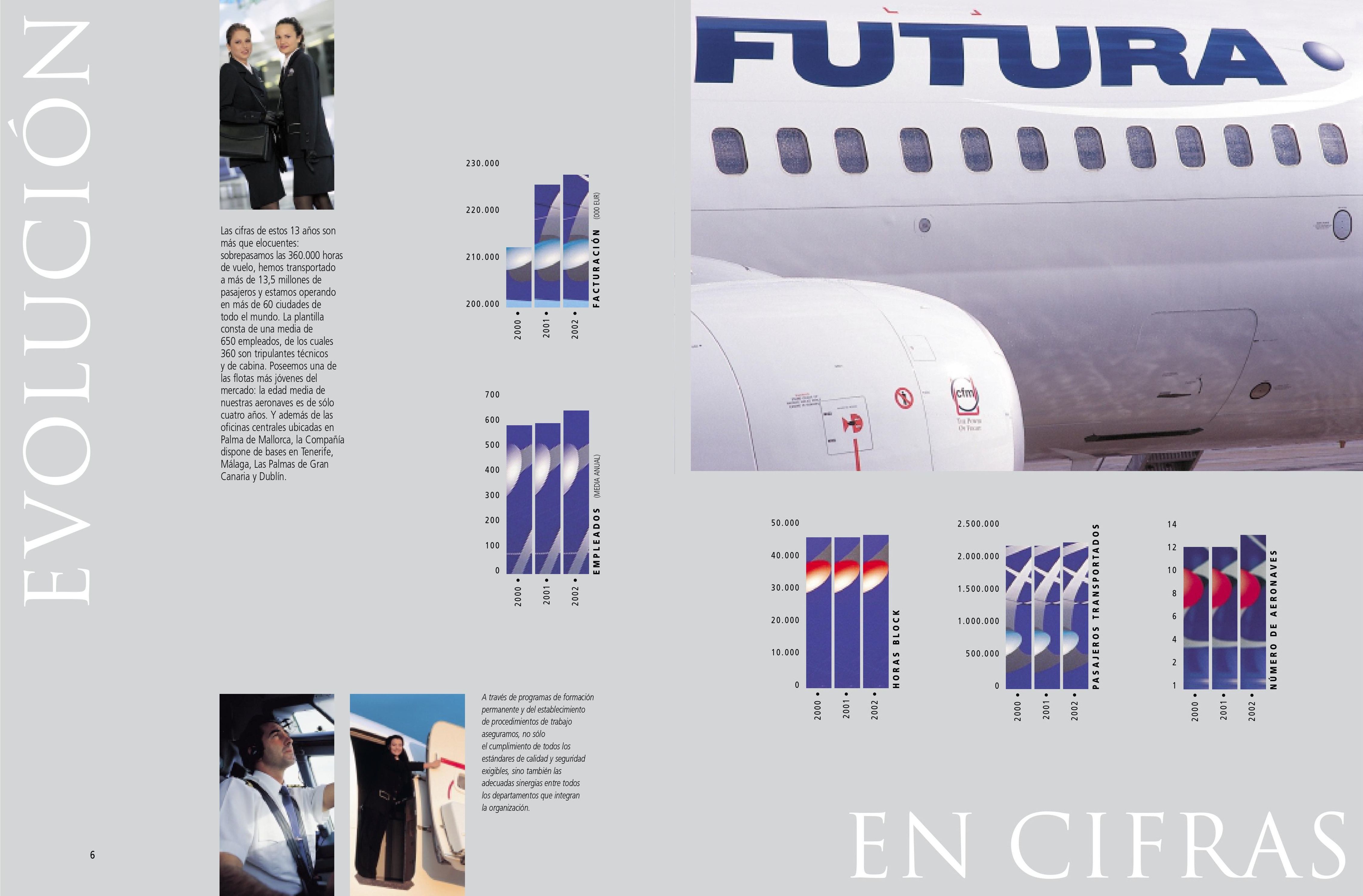
Volar con Futura (2003)

Futura, nacida en 1990 dela mano de Aer Lingus, fue una de las grandes  aerolíneas charter españolas (y tambíén de las últimas), operando de una forma muy clásica en colaboración con tour operadores y enfocada casi al 100% en el mercado turístico y vacacional.  Este es un folleto que da una presentación de la compañía, sus resultados económicos, sus servicios y sus planes de renovación de flota. 

Esta era una época en la que los vuelos charter eran la mejor opción para viajar de forma mucho más asequible y al mismo timepo las compañías hacían un gran esfuerzo por proporcionar un servicio que se pareciera lo más posible al de las grandes compañías regulares. Esto se puede ver en muchos detalles, incluyendo el uniforme de las TCP que pretendía alejarse del modelo vacacional y dar una imagen de seriedad y profesionalidad. 

En cualquier caso, es triste ver como la empresa, que  incluso se aventuró en el mercado regular, terminó cerrando de forma abrupta en medio de una gestión bastante discutible unos pocos años después de que se publicara esta revista. 

✈✈✈ ✈✈✈ ✈✈✈ ✈✈✈ ✈✈✈ ✈✈✈ ✈✈✈ ✈✈✈ ✈✈✈

Futura, born in 1990 as part of the Aer Lingus, was one of the great Spanish charter airlines (and also one of the last), operating in a very classic way in collaboration with tour operators and focused almost 100% on the tourist and holiday market.  This is a brochure that gives a presentation of the company, its financial results, its services and its fleet renewal plans. 

This was a time when charter flights were the best option to travel in a much more affordable way and at the same time the companies made a great effort to provide a service that was as close as possible to that of the big scheduled airlines. This can be seen in many details, including the uniform of the flight attendants, which was designed to give an image of seriousness and professionalism. 

In any case, it is sad to see how the company, which even operated some scheduled flights, ended up closing abruptly in the midst of a rather questionable management a few years after this magazine was published.


Futura Direct (1998/1999)


jueves, 16 de febrero de 2023

Quantum Air (2009)

Aebal era una operadora regional de Spanair, con sede en Palma de Mallorca, 100% propiedad de SAS y que realizaba vuelos para la compañía española con una flota de Boeing 717. 

Tras el cierre de Spanair la compañía fue vendida por SAS al grupo Proturin, adoptó el nombre Quantum Air y comenzó una breve operación en solitario con una nueva estrategia de negocio, centrada en el tráfico vacacional doméstico español y de la mano de un tour operador. 

Desgraciadamente, la compañía dejó de volar apenas un año después, entre acusaciones mutuas entre los nuevos propietarios y SAS

✈✈✈ ✈✈✈ ✈✈✈ ✈✈✈ ✈✈✈ ✈✈✈ ✈✈✈ ✈✈✈ ✈✈✈

Aebal was a regional operator of Spanair, based in Palma de Mallorca, 100% owned by SAS and operating flights for the Spanish airline with a fleet of Boeing 717s. 

After the closure of Spanair the company was sold by SAS to the Proturin group, adopted the name Quantum Air and started a brief stand-alone operation with a new business strategy, focused on Spanish domestic holiday traffic working together with a tour operator. 

Unfortunately, the company stopped operations barely a year later, amid mutual accusations between the new owners and SAS.


 Esta presentación en prensa de los primeros vuelos de la compañía, con su slogan Llegó para quedarse,  es triste y deliciosamente irónica a la vez. La compañía estuvo operando durante apenas un año, en realidad un poco menos. (fuente)

Quantum Air's slogan "Here to stay" turned out to be bitterly sad and ironic at the same time. The airline only lasted about a year in the skies before it was grounded. 


En esa época el mercado doméstico en España estaba ya dominado absolutamente por las estrategias de las low cost, y Quantum pretendía ofrecer una experiencia de vuelo como las de antes, con catering a bordo y facturación y elección de plaza gratuitas. 

Por otro lado, al ser una aerolínea centrada en el viajero que iba de vacaciones a las islas, su oferta era 100% clase turista. 

At that time the domestic market in Spain was already absolutely dominated by low-cost strategies, and Quantum aimed to offer an in-flight experience as in the past, serving light meals onboard and free check-in and seat selection. 

On the other hand, being an airline focused on the leisure traveler to the islands, the airline was offering a 100% economy class cabin. 


Además de las operaciones charter, sus vuelos regulares estaban centrados en las islas, volando a Palma de Mallorca y a Canarias desde Madrid, Barcelona y Bilbao, a la que más tarde se unió Sevilla. 

In addition to charter operations, its scheduled flights were focused on the islands, flying to Palma de Mallorca and the Canary Islands from Madrid, Barcelona and Bilbao, later joined by Seville. 


Mapa de rutas y cuadros de vuelo de la operación regular de Quantum en el verano de 2009

Route map and timetables for Quantum's scheduled flights in the summer of 2009


jueves, 12 de enero de 2023

Pyrenair

España es sobre todo conocida turísticamente por el tópico del sol y playa aunque, evidentemente, hay mucho más, menos conocido y a menudo menos promocionado. 

Entre esos atractivos están el turismo de nieve, y así surgió Pyrenair, una aerolínea virtual que en realidad era un operador turistico que pretendia llevar clientes del resto de España al Pirineo aragonés, fletando para ello aviones de Air Nostrum y de Privilege Style, como el 757 que aparece en la foto.  La compañía presumía, por ejemplo, en 2008, de sus más de 150 vuelos y 7500 pasajeros transportados  y ofrecía desde comprar sólo plazas de avión en sus vuelos a estancias de varios días o incluso ir y volver en el día desde Madrid después de pasar el día esquiando. 

Todo ello volando a/desde el aeropuerto de Huesca, que había sido abierto para vuelos comerciales en 2007, justo antes de la crisis económica, y que hoy en dia no tiene ninguna actividad comercial.

✈✈✈ ✈✈✈ ✈✈✈ ✈✈✈ ✈✈✈ ✈✈✈ ✈✈✈ ✈✈✈ ✈✈✈

Spain is mostly known as a sun and beach tourist destination, although, obviously, there is much more to Spain, often less well known and even less promoted. 

Among those attractions is snow tourism, and thus Pyrenair was launched, a virtual airline that actually was a holiday operator aiming to bring customers from the rest of Spain to the Aragonese Pyrenees, by chartering Air Nostrum and Privilege Style aircraft, such as the 757 shown in the photo. In 2008, for example, the company proudly announced that it had operated more than 150 flights and carried more than 7500 passengers while offering everything from just buying airline seats on its flights to stays of several days or even a day trip from Madrid   after spending the day skiing.   

All this was carried out flying to/from Huesca airport, which had been opened for commercial flights in 2007, just before the economic crisis, and which today has no commercial activity at all. 
 

Los horarios para la temporada de invierno 2009/2010 (la última en la que operó esta no-compañía) en el aeropuerto de Huesca fueron: 

Winter 2009/2010 was the last season when this virtual airline had some scheduled operations, as shown on this timetable: 


Dos postales de promoción de la aerolínea, que se hacía llamar "el telesilla más rápido del mundo". En la segunda se ve que tenían unos ambiciosos planes de expansión por toda la Península que (#spoiler , Chopecha! #no) no llegaron a materializarse: 

Two postcards promoting the airline, which used to call itself "the fastest chairlift in the world". In the second one you can see that they had ambitious plans to expand throughout the Iberia Peninsula that (unsurprisingly) never happened 


viernes, 6 de enero de 2023

Aviaco (1980) [completo]

No es ningún misterio que en este blog somos especialmente fans de la que fue, durante muchísimos años, la segunda principal compañía española, aunque gran parte de su historia sometida y a la sombra de Iberia que fue la que finalmente la absorbió. 

A principios de la década de 1980 Aviaco tenía presencia en el mercado doméstico (fundamentalmente como operador secundario) y mantenía su histórica ruta entre Palma y Argel; sin embargo, había planes de crecimiento tanto en la red interna como en el mercado charter internacional, que era una actividad muy importante para la empresa. 

De hecho, en estos planes de crecimiento estaban incoporar aviones de fuselaje ancho para operar vuelos de larga distancia, que se realizaban entonces con la flota DC-8. Aviaco nunca llegó a tener este tipo de aviones en su flota, pero si no recuerdo mal si llegó a volar con DC-10 alquilado a Iberia. 

✈✈✈ ✈✈✈ ✈✈✈ ✈✈✈ ✈✈✈ ✈✈✈ ✈✈✈ ✈✈✈ ✈✈✈


It is no secret that in this blog we are especially fond of the airline which was, during many years, second largest Spanish airline, although most of its history was subordinated and in the shadow of Iberia, the airline that eventually absorbed it.

In the early 1980s Aviaco had a significant presence in the domestic market (mainly as a secondary operator) and continued to operate its historical route between Palma and Algiers; there were, however, plans for growth both in the domestic network and in the international charter market, which was a very important activity for the airline.

In fact, these growth plans included the purchase of wide-body aircraft to operate long-haul flights, which were then operated with the existing DC-8 fleet. Aviaco never managed to have this type of aircraft in its fleet, but if I remember correctly it did fly with DC-10 leased from Iberia.  


Contribución de Jacinto M. Garau Florit  ¡Muchas gracias por tu escaneo de este horario de Aviaco!